
Don’t Give Them Certainty. Give Them Agency.

If you’d prefer to listen to this, click here.
Last week I was working with the executives and senior leaders of one of New Zealand’s local government agencies. We were using the Changing the Game methodology to help them think about how they can lead effectively in a tough, under-resourced, uncertain environment.
I asked them what the most challenging aspect of their leadership was. Several of them replied, “We can’t give our people certainty about what will happen.”
I found myself saying, almost out of thin air, “Don’t give people certainty. Give them agency.”
That created the foundation for the rest of our session.
When uncertainty looms large, the pressure to provide answers as a leader looms just as large. We might reach for answers, yet we find them lacking, or at least, lacklustre.
We have some choices. Here’s what that looks like:
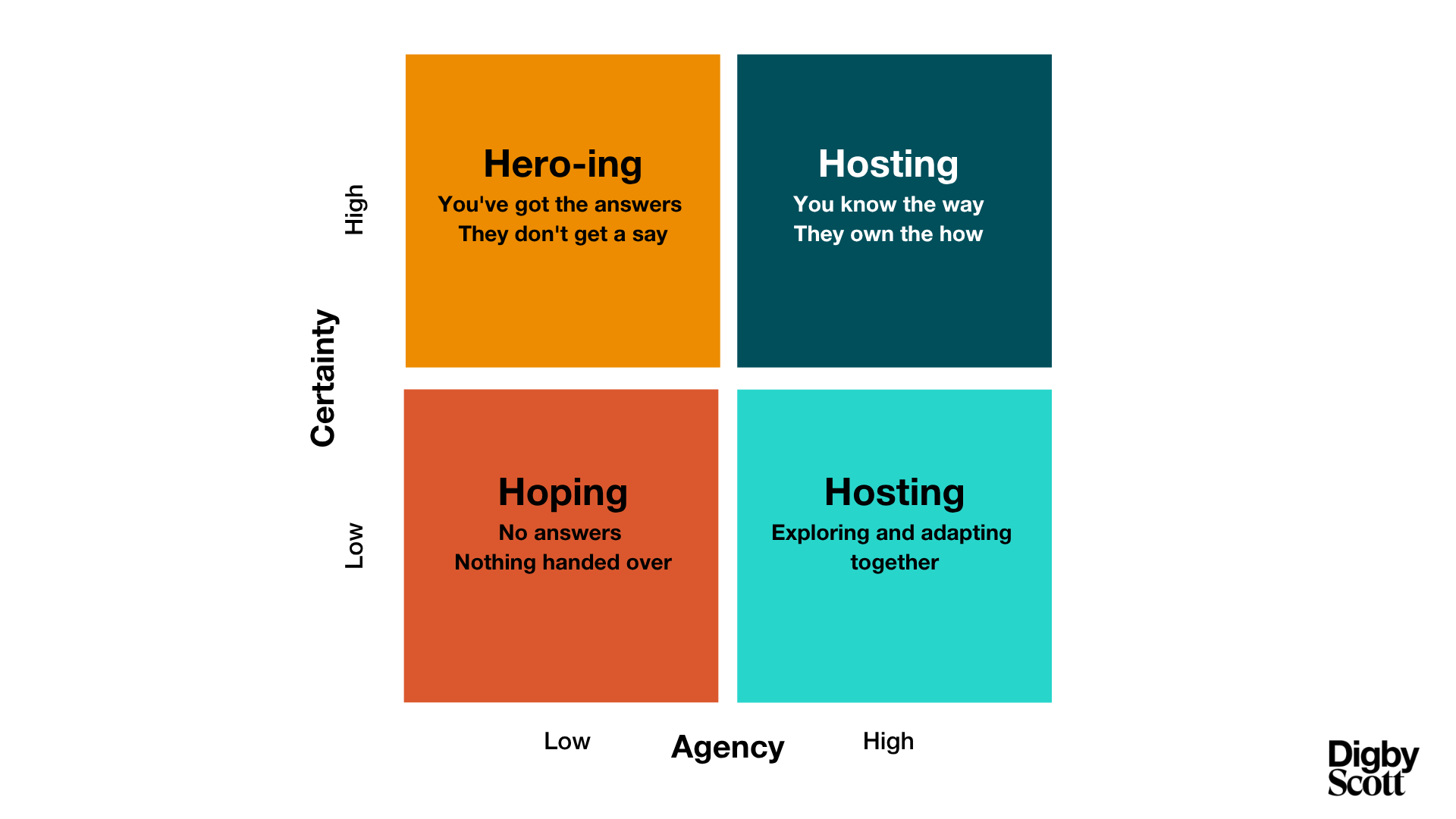
Hero-ing (high certainty, low agency). You've got the answers, or, at least, you're performing as though you have them. “Trust me, I've got this.” This works in the short term, but it breeds a fragile compliance. The moment you're not there, nothing holds together because it was never really anyone else's to begin with.
Hoping (low certainty, low agency). This is the leadership vacuum. There are no answers, and nothing’s being handed over. You’re not deciding, not steering, and not hosting. It's often invisible because it doesn't look like failure the way hero-ing does when it collapses. Instead, it just leaves people stranded with no plan and no agency to make their own.
Hosting (high agency, regardless of certainty). A hosting leadership style is about bringing people together to pool what everyone's thinking. This is the mode that matters. Agency is what defines it, not whether you happen to know the answer. There are two flavours of hosting:
Hosting with clarity: you know where you're headed, but you still hand over agency in how people get there.
Hosting into the unknown: you don't have the answers. You bring people together to figure it out collectively.
When you’re in ‘host mode’, it’s like sailing a boat in changing weather. You can't control the wind, so a good skipper hands the crew the ropes and lets them adjust the sails rather than pretending they know exactly where the wind's going. Sometimes you can see the destination, sometimes you can’t, but in either case, empowering the crew is the thing to do.
Certainty is a promise you can’t keep. Agency is a gift you can always give.
Self-Determination Theory tells us that autonomy is one of three core psychological needs. That’s the sense that what you're doing is your own choice. When people have a sense of autonomy, they cope far better under stress, even when the outcome itself is out of their hands.
Autonomy is the need. Agency is what a leader actually supplies to meet it.
A study in a nursing home in the 1970s matched groups of elderly residents. One was given small choices, like picking their own plant and choosing when to watch a movie. The other had everything decided for them by staff. Eighteen months later, the ‘choice’ group was happier, more active, and had a lower mortality rate: 15% in the choice group vs. 30% in the comparison group.
Don’t give people certainty. Give them agency.
Courage in the face of structural forces.
This is not easy. In my own work, as a facilitator and coach, even after all these years, I still feel a tension: for any given issue, some part of me wants to make it more comfortable for them by providing answers or reassurance, while knowing that it’s their issue to wrestle with. I need to remind myself that my job is to sit with their discomfort, not solve it for them.
You might read all this and think leaders who default to certainty are just being lazy or egotistical. But that's rarely the whole story. Boards want confidence, media want soundbites, and most performance systems unwittingly punish anyone who says “I don't know yet”. On top of that, in many New Zealand and Australian workplaces, admitting uncertainty is translated as weakness rather than honesty. Choosing agency over certainty is often a hard swim against the current of the prevailing culture. That takes courage, not just good intentions.
Most leaders still feel the pull to sound certain even when they know better. To rise above that pull, it takes a few things working together: Having a small circle of people who'll tell you the truth rather than just reassure you, so you're not swimming against the current alone. Having enough clarity about your own values that the pressure to perform certainty has less grip on you. And practising honesty in the small moments, the everyday decisions, so the muscle is already built before a real crisis tests it.
Ultimately, courage means trusting the relationship with your people more than you trust the performance of having all the answers.
The hero performs certainty. The host creates conditions.
Lasting impact happens when people own their part, not because a leader promised it would work.
Don’t give people certainty. Give them agency.
What agency could you give your people this week?
