

Image credit Digby Scott/ Midjourney.com
If you’d prefer to listen to this, click here.
When people are undergoing rapid, real change, what’s the advice most often given?
What I hear most is “focus on what you can control rather than what you can’t.”
It’s sound advice. Thanks, Stephen Covey, for your circle of concern/circle of influence legacy!
Yet it’s only half the story.
Focusing on what you can control gives you a sense of agency. That’s the capacity to take action, make independent choices, and exert some degree of influence or control over what happens next. All good stuff.
Agency Isn’t Enough.
But what if you’re operating with blinkers on?
What if you think you know what’s going on, but you’re actually missing a big piece of the picture?
Like when a new manager changes the process before finding out why the old one existed.
Or when a leader reorganises the team to fix a performance problem that was actually about unclear goals.
Or the leader who swoops in to solve everyone’s problems, because that’s what they think their job is.
Acting with agency in this context can set you up for a world of pain.
Years ago, a lift operator found me at the top of a chairlift on a ski field, waving a phone message: "You need to call the office. It's urgent." I was the national manager of a recruitment firm, badly out of my depth, and I'd gone snowboarding specifically so nobody could reach me. The emergency wasn't one. It never was! But the ride down was long enough to ask myself a question: how had I built a job where the only way things kept moving was for someone to track me down on a mountain?
I had agency in spades. I was always in motion, always solving, always the one people came to. What I didn't have was any awareness of what that pattern was actually costing me, or the people around me who'd stopped needing to grow, because I was always there to solve it for them.
Acting without awareness is a bit like being given a Trojan horse. The Trojans were given the horse. They had the motivation and the means to bring the horse inside. But nobody thought to ask what they hadn't seen yet. And they paid the price.
Awareness Without Agency.
Conversely, awareness without agency has its own cost. That’s when you can see exactly what’s going on, but there’s nothing you can do about it.
Like the frontline staff member watching customers get frustrated by a policy they have no authority to change.
Or the junior analyst who can see the numbers don't support the strategy, but isn't in the room where it gets decided.
Or when you’re simply watching the news headlines.
Cassandra saw the fall of Troy with total clarity but was never believed. When the wooden horse arrived, she desperately screamed that it was filled with armed Greek soldiers. The Trojans ignored her and brought it inside. And the rest is history.
While awareness without agency is frustrating for an individual, it also leads to missed opportunities for the team and organisation to make wise decisions and take smart action.
Don’t Get Stuck.
What if you have neither agency nor awareness?
This is a team on an indefinite hiring freeze, no timeline given, and no way to plan around it.
Or staff going through a company merger's due diligence period, deliberately kept in the dark, unable to plan their own next move.
This is Groundhog Day, where you’re stuck reliving the same day, with no idea why and no way out of it.
For me, this often shows up as writer’s block. I write every week, but sometimes my every effort to write something useful results in a frustrating stall! My brain seems to just want to switch off. You should see my folder of half-written articles!
You Need Both.
When you have both agency and awareness, you’re solid:
Like the new manager who spends the first month asking questions before changing anything.
Or the manager who regularly walks the floor to see what's actually happening rather than relying on the report, and adjusts the plan based on what they find.
This is the scientific method: have a hypothesis, test it, observe what happens, and adjust. It’s a loop of curiosity and deliberate action.
The Four States.
Let’s put those two ideas - agency and awareness - together:
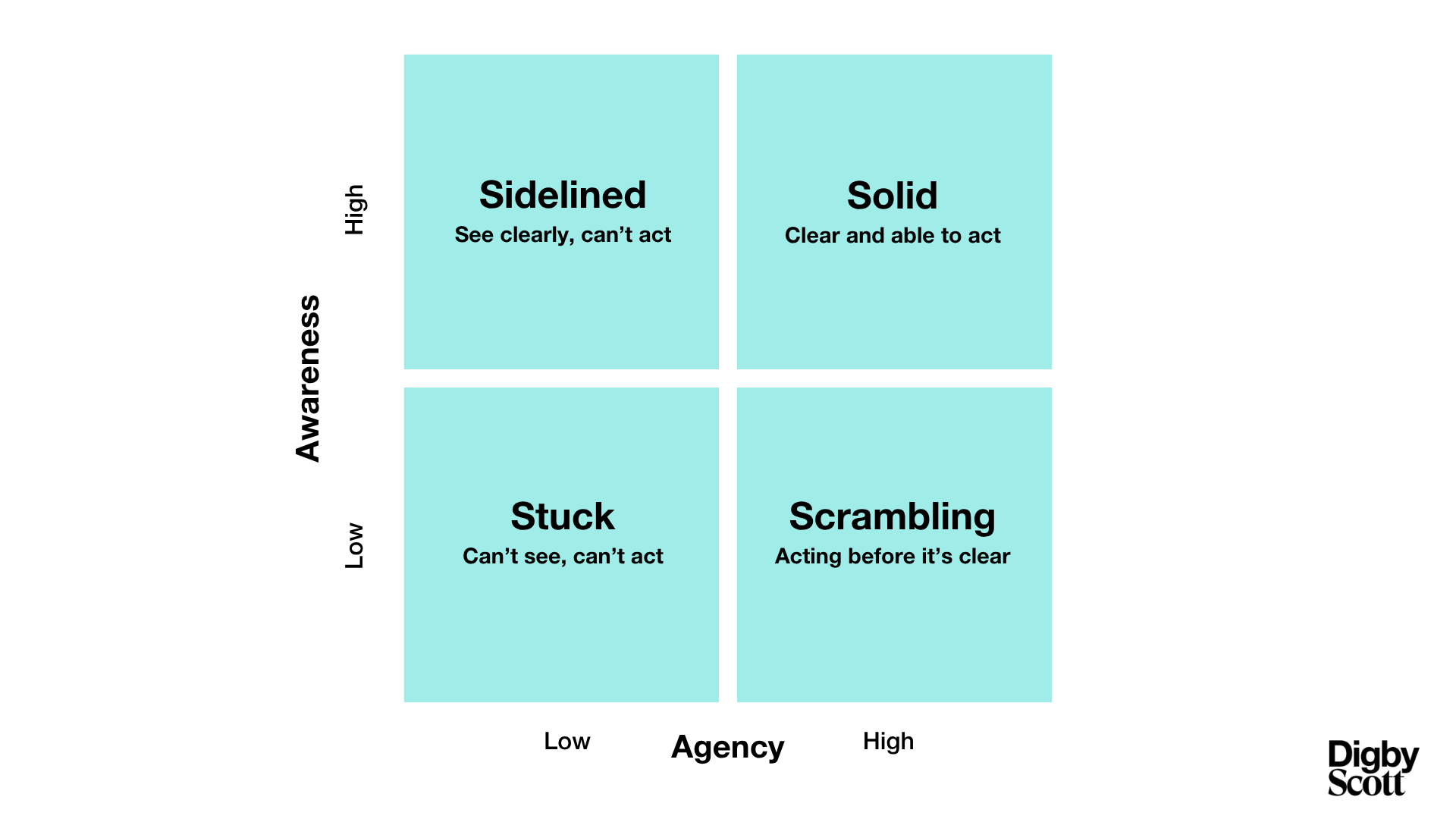
When you have high agency but low awareness, you’re scrambling. You’re in action, aiming for results, but ill-informed.
When you have high awareness but low agency, you’re sidelined. You’re unheard, frustrated, and potentially disengaged.
And without either agency or awareness, you’re simply stuck.
What you need is for you and your people to be solid on both fronts. This is not about having perfect information or taking heroic action. This is about blending a healthy curiosity with deliberate experimentation. It’s about taking deliberate action, and noticing the impact, with eyes wide open, blinkers removed.
Creating the conditions.
How can you create the conditions for agency and awareness?
If you find yourself or your people in one or more of these boxes, here are some practical ways to shift things:
From Scrambling to Solid:
Pause before you commit: what problem am I actually solving?
Get a second vantage point before you finalise anything.
Name the pattern out loud: “Am I racing to the red light?”
From Sidelined to Solid:
Bring the fix, not just the warning: you’ll get a better hearing if you bring both.
Build influence before you need it: invest in relationships early.
Separate the organisation’s problem from your problem: caring about the outcome doesn't mean it's a verdict on you.
From Stuck to Solid:
Run a ‘control audit’: what's actually yours to move?
Chase one fact, not the whole picture: you don't need to see it all, just the next true thing.
Borrow someone else's clarity: ask the person who isn't standing where you're standing.
Maintaining and growing Solid:
Keep inviting challenge: certainty is different to clarity.
Give your agency away, don't hoard it: solid isn't about being the only one who can act.
Guard your energy, not just your judgement: good judgement doesn't survive running on empty.
What box do you find yourself in most often? Personally, my biggest challenge is to get out of the scrambling box. As much as I love to be unhurried, I also love being in motion, and sometimes that just trips me right up.
"Focus on what you can control" isn’t bad advice. It's just half of the story. Get as curious about what you can't yet see as you are decisive about what you do next. Ask the question. Seek the other vantage point. Then act, and keep watching what happens.
Getting to Solid is easier with company. Leading Lasting Impact is a six-month group coaching programme for 6-8 senior leaders navigating real change together. High trust, high accountability, with real peers who get it. Enquire here.
