
How to Lead from the Edge of Things
If you’d prefer to listen to this, go here.
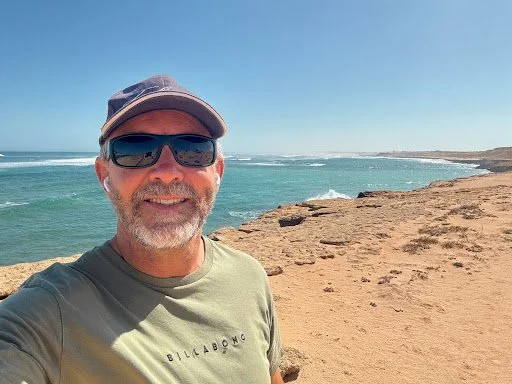
I’ve recently returned from my annual windsurfing trip in a remote, rugged region of north-west Western Australia. It’s been 26 years since I was first drawn to this place - wild, raw, and unrelenting, nestled under a massive sky. Along with some good mates, I spend two to three weeks off the grid, existing between the ancient continent and the vast Indian Ocean. It’s awe-inspiring.
I’ve often reflected on why I’m drawn to such a place, and more generally, like so many of us, drawn to the coast where the ocean meets the land. I reckon it’s a powerful metaphor for what it means to lead well.
Here are some thoughts, and questions, about that:
The edge exists where the ever-changing meets the never-changing.
The coast exists where the ever-changing ocean meets the never-changing land (well, the very slowly changing land!) Leaders exist between the stability their organisations crave and the change the future demands. What if this tension isn't something to resolve, but something to inhabit?
The ocean is never the same twice, yet the coastline remains.
As leaders, we have to hold both - responding to what's immediate while maintaining what endures. How the hell do you stay grounded when everything around you is in motion?
Both masses - the water in front of us and the land behind us - are huge compared to our tiny, puny bodies.
We’re nuts if we think we can change these gigantic forces. Yet we can learn to work with the dynamic that’s created when they meet. That’s why I think riding waves is such a pull for me: every wave is different, yet I can learn to read patterns of the swell. The more I get to know those patterns - how many waves in a set, how the waves change as the tide goes in or out - the better I am at finding the sweet spot (and yep, I still get smashed plenty of times!)
The space between is where the richest life exists.
At the coast, that’s called the ‘intertidal zone’. It’s neither fully ocean nor fully land. It’s in this space where leadership actually happens, not in the safety of either extreme. If we want to breathe life into our teams and organisations, we need to operate from where things are most dynamic. That’s the space between.
You can’t get too comfortable on the edge.
As a kid, I was given some sage advice: never turn your back on the ocean. Because it can come and floor you when you’re not looking. You’ve got to be constantly alert to what might be coming at you - both quickly (a rogue wave) and slowly (the changing tide) because the landscape is never static. I think all too often we fail to read the signs before it’s too late. One of the core leadership skills we need to cultivate is not about being in action - it’s about slowing down and noticing how things are evolving, and anticipating where things might go next.
Challenges and Opportunities
Being at the edge of things presents us with both challenges and opportunities. Here’s a few:
Challenges:
The exhaustion of constant movement. Waves don't stop
The erosion that happens slowly, imperceptibly, until suddenly the cliff face gives way
The loneliness of standing at the edge when others prefer the safety of solid ground
The temptation to retreat fully to land (control, certainty) or, for some of us, to dive into the ocean (chaos, constant change)
Being misunderstood by those who operate from either extreme
Opportunities:
The edge is where the most interesting discoveries happen
You develop different capabilities here - balance, awareness, adaptability
You can see what's coming before it reaches the organisation
You create conditions for new things to emerge (like tidal pools nurturing life)
You become comfortable with uncertainty as a constant companion, not a problem to solve
Some questions for leaders:
Where do you find yourself right now - standing at the edge, or have you retreated to safer ground?
What would it mean to stop trying to control the ocean and instead learn to read its rhythms?
Who else stands at this edge with you? How might you support each other in this exposed position?
What's being revealed to you from this vantage point that others can't yet see?
If you accepted that the tension between stability and change will never resolve, how might you lead differently?
What would it look like to create "tidal pools" in your organisation - protected spaces where new things can emerge before they're ready for the full force of either system?
When you feel the erosion happening - to your energy, your relationships, your vision - what are you noticing? What might that be telling you?
One final thought and one final question.
What if you thought of yourself as a lighthouse keeper? You're not trying to stop the waves or hold back the land. You're there to provide orientation for others navigating these same forces. What does it mean to be a point of reference rather than a controller of outcomes?