
Five Ways To Mentor Others

If you’d like to listen to this instead, go here.
As we grow more experienced in our leadership, it becomes more likely that we’ll be asked to mentor others. And the more senior we become, the more evident it becomes that we need to shift our focus from being the go-to hero with the answers to becoming the leader who creates the conditions for others to step up and lead.
But how do you do that? What even is mentoring? You know that it’s more than just telling people what you’ve achieved and how you did it. What does it actually take?
My own challenge with this has been the story I’ve previously told myself that it’s all about ‘knowledge transfer’: passing on my expertise and wisdom to others. Yes, that’s a part of mentoring. But if you’re serious about developing people, relying solely on knowledge transfer as a way to develop others can severely limit what’s possible.
Broaden Your Perspective
What if we broadened the idea of what mentoring involves? What if it wasn’t just about being a font of wisdom, but instead it’s about becoming a partner who’s deeply invested in someone else’s growth?
In my work supporting leaders to learn to mentor others, I use a simple model that covers five roles that leaders can play. I’ve noticed that broadening the perspective of what mentoring involves helps leaders to ‘breathe out’. They realise that mentoring can take many forms, and they don’t need to be the ‘guru’.
Let me take you through the model, including the essence of each role and some useful practices:
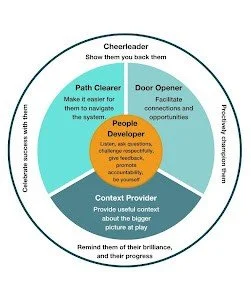
People Developer (The Core)
At the heart of mentoring sits the work of genuine development. This isn't about having all the answers or fixing someone else's problems. It's about creating the conditions where growth becomes inevitable.
Listen deeply to what sits beneath the words
Ask questions that open up new thinking
Challenge respectfully whilst staying in their corner
Give feedback that's honest and specific
Promote accountability through ownership, not policing
2. Cheerleader (Show Them You Back Them)
People working at pace can often lose sight of their own brilliance. The daily grind, the complexity, the weight of decisions all accumulate. Sometimes, the most powerful thing you can do is reflect back to them what you see.
Remind them of their brilliance and progress
Champion them in rooms they're not in
Celebrate the journey, not just the outcomes
Reflect back the capability they've forgotten that they have
3. Path Clearer (Make It Easier to Navigate)
Organisational life is full of invisible obstacles. Politics, unclear processes, competing priorities, bureaucratic maze-making. As a mentor, you've likely walked these paths before. You can see the trip hazards they're about to encounter.
Remove unnecessary friction and obstacles
Help them navigate the political landscape
Show them shortcuts without cutting corners
Point out the switchbacks that make the climb manageable
4. Door Opener (Facilitate Connections)
Leadership development isn't just about what you know; it's about who you know and who knows you. Your network is one of the most valuable assets you can share.
Make strategic introductions that expand thinking
Create visibility with the right audiences
Broker opportunities for useful stretch experiences
Lend them your credibility through your relationships
5. Context Provider (Illuminate the Bigger Picture)
Everyone operates with only partial information. People see their slice of the organisation but can miss how it connects to everything else. You can change their altitude.
Share the strategic narrative behind decisions
Explain competing priorities and trade-offs
Provide historical context to save wasted effort
Connect the dots between seemingly separate initiatives
Each of these roles serves a different dimension of development. The art of mentoring lies in knowing which role is needed when, and being fluid and fluent enough to shift between them as the person's needs change. Sometimes in a single conversation you'll move between all five. What matters is staying attuned to what will serve their growth most in this moment.
You can download a PDF of the model and descriptions here.
Three practical things you can do now:
Review the five roles. Give yourself a rating of 1-5 on how effective you are at each. Leverage your strengths. Make a plan (e.g. training, or get your own mentor) to strengthen the lower-scoring ones.
Share this model with someone you’re mentoring or coaching. Ask them what role(s) they think they’d most like you to play for them. Have a copy of it on the table in your next meeting to reference as you go.
Contact me if you’d like to talk about how to grow your organisation’s leaders' ability to develop their people.