
The Four Questions That Change Everything

If you’d prefer to listen to this instead, click here.
”All great acts of genius began with the same consideration: Do not be constrained by your present reality.”Leonardo Da Vinci
What if your leadership impact came down to just four types of questions?
A few years ago, I was in a board meeting for a company I was part of. Often, these meetings were pretty dry and very 'numbers-focused'. A lot of going through the motions, with not a lot of new forward motion.
This time it was different.
As we began the session, the chair framed things up with a simple question: "What's the real conversation we need to have here today?"
Pin drop moment. Silence. Until eventually someone piped up, "I think we need to have a conversation about the story we're telling ourselves about our uniqueness in the market. I'm seeing new competitors popping up everywhere, and I think we need to have a good look at our strategy."
You could sense a subtle shift in the energy in the room. Finally, something real to work on together! That single question changed what could have been another forgettable meeting into our most strategic conversation of the year.
Here's the thing: we often default to the same questions in every situation. The easy questions. The obvious questions. The questions that might give us the answers we're looking for ("How profitable were we this quarter?"), but not the questions that take us somewhere ("How sure can we be that we can sustain that profit over time? What assumptions are we making here?")
I see this not just in governance circles, but in leadership at every level. As Einstein might have said (if he'd been thinking about questions), "We cannot solve our problems with the same level of questions that created them."
If we want our conversations, at any level, to have real impact and create forward motion, there are four types of questions to ask:
What: questions that set and clarify our focus for the conversation
What Is: questions that help us interrogate and understand what's going on more clearly
What If: questions that ignite possibility
What Now: questions that create a sense of progress and momentum
Let's explore those further:
What
Conversations go better when we’re clear about the territory we're in. ‘What’ questions help us set and clarify that territory from the start. Use these questions at the beginning of a conversation or meeting. Questions like "What's the purpose of this conversation?", "What would a good outcome look like?" "What time do we have?" "What's most important/interesting to focus on here?" Get these questions answered first, and you set yourself up for a productive conversation.
What Is
Productive conversations always have an element of discovery. ‘What Is’ questions invite us to get beneath the surface to where the real stuff is. To 'what is' actually going on. The unexamined stuff. The stuff that, if we're courageous enough to shine a light on it, can show us what the real issues are, and point to new possibilities. Use these questions once you've set and clarified your focus for the conversation. Questions like "What is the assumption we're holding here that we need to test?" "What is a question we aren't asking?", "How might this issue be a part of a larger pattern?" These questions, while maybe uncomfortable to ask, get us to real. And we can work with real.
What If
If ‘What Is’ questions ask us to examine what is going on, ‘What If’ questions ask us to imagine what might be possible. Once we've had a good look at the territory, we can begin to think about how we might move through it differently. Questions here include "What if we optimised for resilience rather than performance?", "What if we let go of the need to…?" "What if we framed this in terms of what the next generation would thank us for doing now?" These questions aren't about analysing the pros and cons. They're about opening up our thinking to see things in new ways.
What Now
‘What Now’ questions bring it home. After some solid interrogation of reality and some energy-shifting possibility-generation, we need to land a plan. ‘What Now’ questions help us determine a course of action and accountability. Questions here include "What's the step we need to take now?" "How will we check in and follow up on this?" "How will we measure the effectiveness of this decision?" ‘What Now’ questions give you something concrete to action and to loop back on.
Together, these questions form a framework that looks like this:
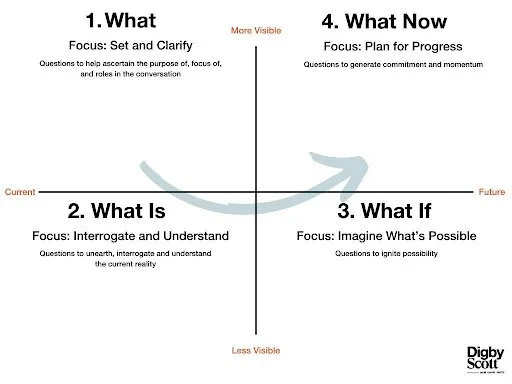
I call this the 'Surface-Piercing Questions' framework. Most conversations stay safely above the surface with the obvious What and What Now questions. The breakthrough happens when you're brave enough to go beneath the surface with What Is and What If. That's where the possibility for real change lives.
How to Build This Into Your Leadership Practice
Knowing these four question types won't change anything unless you actually use them. So here are three practical ways to make this framework stick:
1. Prime Your Next Meeting
Before your next team meeting or one-on-one, spend a minute to ask yourself: "Which quadrant does this conversation need most?" If you're kicking off a project, lean into ‘What’ questions. If the team seems stuck, try ‘What Is’ questions. If energy is low, reach for ‘What If’ questions. If you've talked enough, shift to ‘What Now’ questions.
2. Create a Question Card
Write one example question from each quadrant on a card and keep it visible during meetings. I guarantee you'll catch yourself defaulting to the obvious questions, and having these alternatives right in front of you makes it easier to choose differently. (You can download a ready-made version at digbyscott.com/questionstoolkit )
3. Name the Shift
When you're moving between question types, say it out loud: "We've done good work clarifying what we're here for. Now let's dig a bit deeper - what's really going on here that we need to understand?" Naming the transition helps everyone in the room understand the journey you're taking them on.
The goal isn't perfection. It's progression. Start noticing which questions you naturally gravitate toward (most of us have a default type), and then deliberately practice the ones that feel less comfortable. That's where your growth as a leader lives.
The Challenge: Pick One Type to Practice This Week
So here's my challenge to you: Choose just one type of question to focus on for the next seven days.
Maybe you're great at getting to action (What Now) but skip the discovery phase (What Is). Or perhaps you're brilliant at possibility-thinking (What If) but struggle to clarify the focus upfront (What).
Pick the quadrant that feels least natural to you - that's probably where the most value lies. Then, in every meeting or significant conversation this week, ask at least one question from that quadrant.
Notice what happens. Notice how people respond. Notice what new insights emerge. Notice how the quality of your conversations shifts.
Why This Matters
The questions you ask determine the conversations you have. The conversations you have determine the decisions you make. And the decisions you make determine the impact you create.
What question are you going to ask this week that you wouldn't have asked before?
Want to go deeper?
Download the Surface-Piercing Questions toolkit with example questions for each quadrant at digbyscott.com/questionstoolkit.
Listen to these episodes of the Dig Deeper podcast: