

Image Credit: Emma Simpson, Unsplash.com
If you’d prefer to listen to this, click here.
I recently wrapped up a leadership programme for a large New Zealand government department. In our final session, I asked participants what they’d noticed about themselves having completed the programme.
Here are their answers:
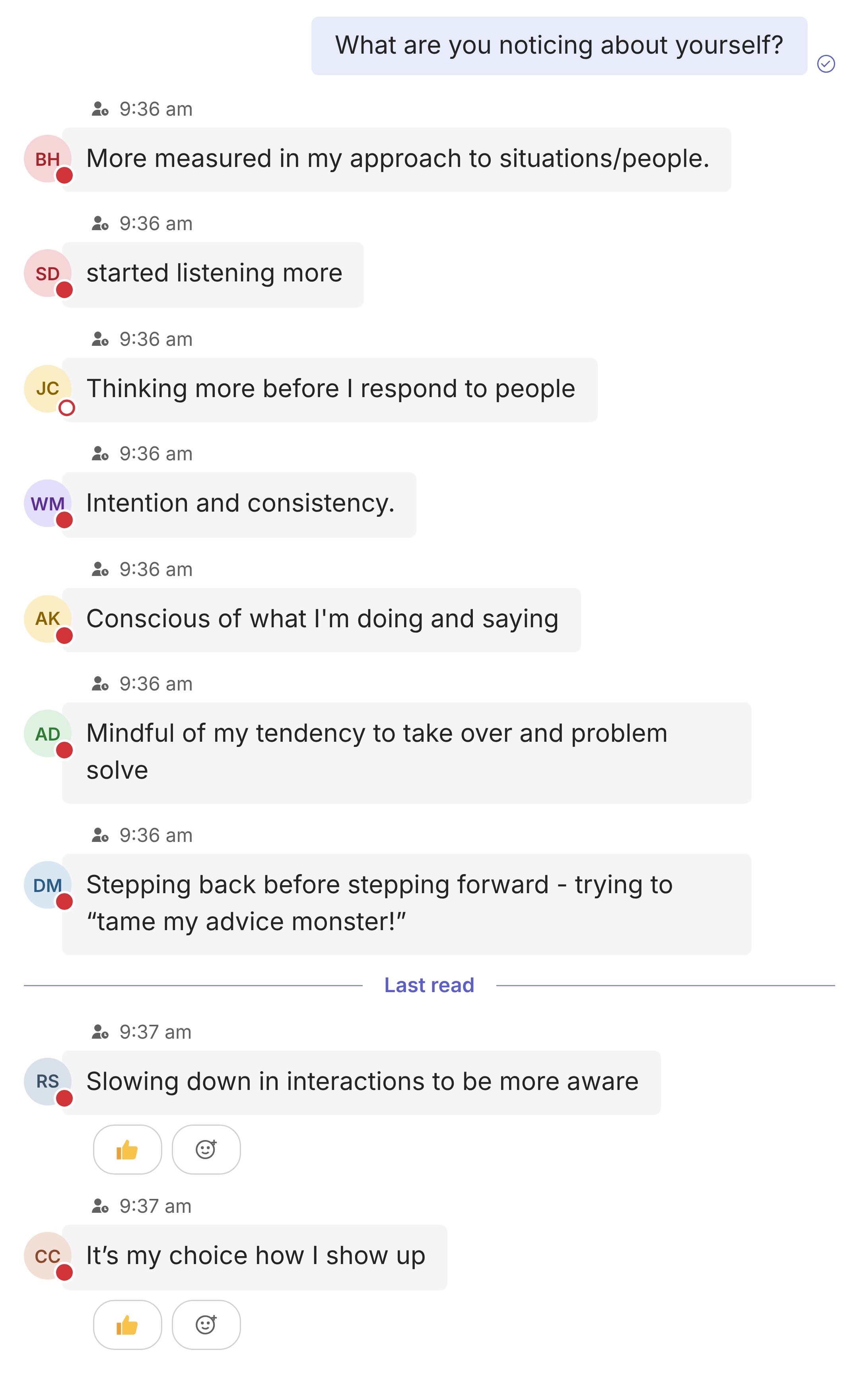
What do their answers have in common?
Every quote in that list is about pausing, noticing, and considering before they take the next step.
These leaders are now more measured. They’re paying more attention. They’re listening more deeply. They’re thinking before responding. In short, they’re more aware.
Awareness matters because awareness brings choice. When you dial up your awareness, you’re more likely to see more of the field of play. You have more choice about what you do next. You have a better chance of making more informed decisions.
It’s like walking the same road you drive every day. When you slow down, you see more. You get a fuller picture.
Korn Ferry Institute’s research found that, compared to people in strongly performing organisations, those in poorly performing organisations had 20% more blind spots and were 79% more likely to have low overall self-awareness.
I’ve noticed that as I get older, I’m slower to respond than I was in my 20’s. That’s not just a capacity thing. It’s a deliberateness thing. Experience has taught me that if I take a beat more often, and think a little more deliberately before I make my next move, I make choices that serve the longer game that I’m playing.
Awareness matters, and it needs to be a core outcome of any leadership development initiative.
The vast majority of leadership programmes focus on teaching content, assuming awareness follows automatically. But awareness is the actual capability. It has to be built directly rather than implied. While tools and models are useful, if you’re not using them with awareness, you’re missing the whole point of leadership.
Becoming Aware
How do you grow awareness, even if you’re not on a leadership programme?
Self-awareness can be split into two types:
Internal: your own values, thoughts, and behaviour.
External: how others actually experience you.
These two don't correlate. You can be highly reflective and still have real blind spots, because reflection only ever tests your version of events against itself. You shrink your blind spots only by getting feedback, not by thinking harder.
Some practical thoughts on growing your self-awareness:
Build Your Reflective Practice
Ask a specific end-of-day question. "Where did I react instead of choose?" or "Where did I take over instead of asking?"Articulating your answer is the thing that makes the difference. Write down or say it out loud.
Notice your body in the moment. Do you get a tight jaw, speak faster, or breathe up in your chest? These signals tell you that you've shifted into reacting before your thinking has caught up. Develop the skill to name something while it's happening, rather than simply reflecting on it that night. The benefit is that it helps you choose what happens next, in the moment.
Watch for the pattern. One bad meeting doesn’t tell you a lot. But if you have the same reaction showing up across three unrelated situations, it can tell you something real about you, beyond the circumstances.
Seek Feedback
Ask a specific person a specific question. Go beyond "how am I doing?" A vague question gives you a vague answer. Instead, try, "What's something I do in meetings that I might not notice?"
Go wider than your direct reports. Direct reports have the most to lose by being honest with you. A peer, someone from a previous role, and someone outside work will each see a different perspective.
Most importantly: make it safe to tell you the second time. Most people will test the water with one small piece of feedback to see how you take it. If you get defensive, it’s likely that that's the last honest thing they'll offer you.
Practice both reflection and feedback. Reflection without feedback just refines your own story. Feedback without reflection is data you don't do anything with.
“It's my choice how I show up.” This sentiment from one participant nails it. Grow your awareness and make those moments of choice matter.
For more like this, check out:
